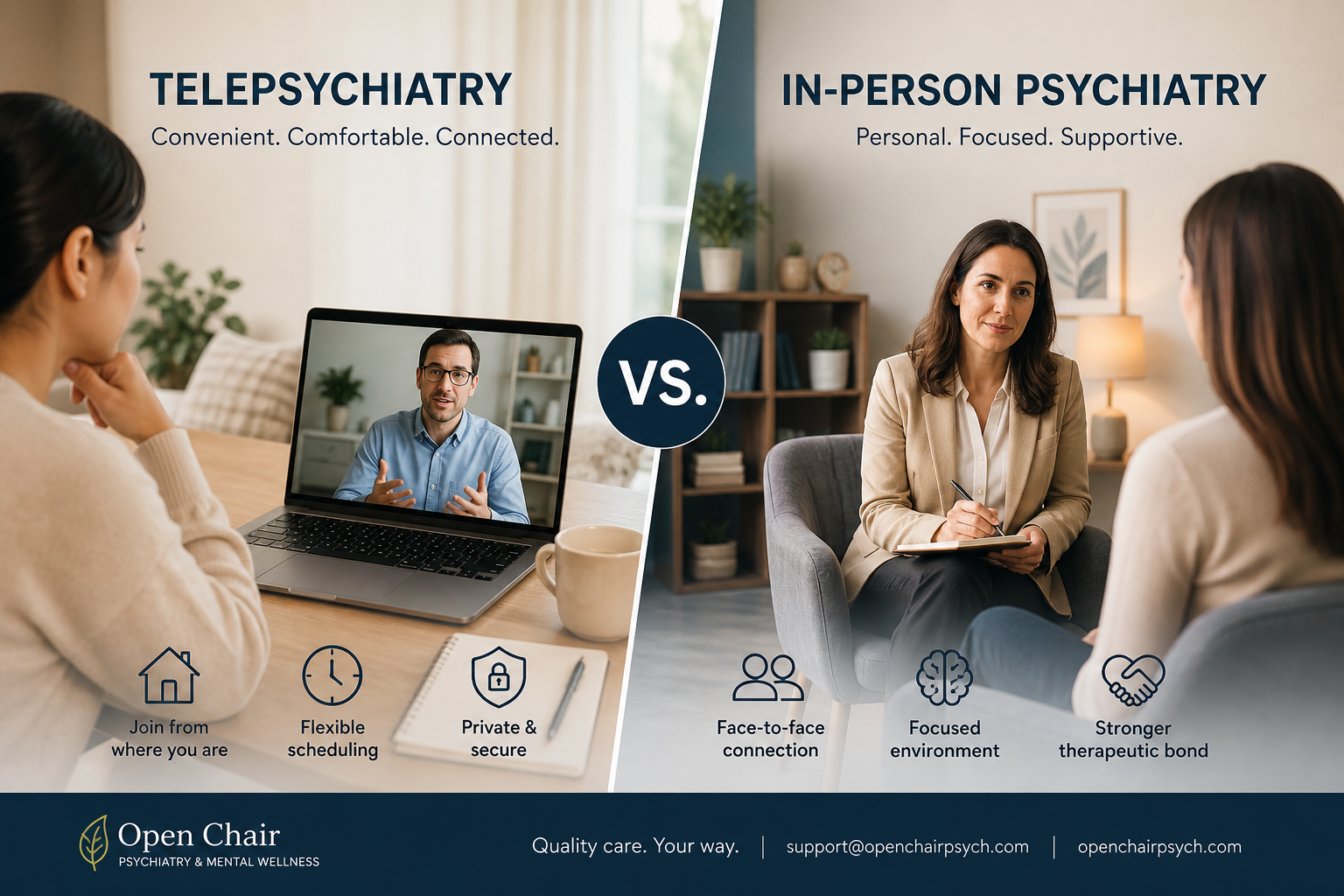
Telepsychiatry vs. in-person psychiatry: what the research actually says.
The honest version. What the research shows, where the differences matter, and how to know which fits your situation.
Knowing what the research shows about telepsychiatry vs in-person psychiatry can make this decision feel a lot less uncertain.
If you’re weighing telepsychiatry vs in-person psychiatry, you’re asking the right question. Here’s what the research actually shows about how online psychiatric care compares to traditional in-office visits, and how to know which fits your specific situation.
If you’re considering psychiatric care, one of the first questions you’ll run into is whether telehealth is “real” care — whether seeing a provider through a screen counts as much as sitting across from one in an office. It’s a fair question. The honest answer is: for most psychiatric care, the research says yes. With some important caveats.
Here’s the honest version of what the research shows, where in-person still has advantages, and how to know which is the right fit for you.
5 things to know about telepsychiatry vs in-person care
If you’re short on time, these are the five things worth knowing before deciding between telepsychiatry vs in-person care. Each one is expanded in the sections below.
- 1 For most outpatient psychiatric care, outcomes are comparable. Decades of research show similar symptom improvement, satisfaction, and treatment engagement whether visits happen online or in person.
- 2 Telepsychiatry often improves medication adherence. When commute, parking, and time off work disappear, patients miss fewer appointments and stay engaged with care longer.
- 3 Therapeutic rapport forms reliably over video. Trust and connection develop on similar timelines whether visits happen in person or by video — this was studied closely and the finding has been consistent.
- 4 In-person remains better for specific situations. Active crisis, severe symptoms requiring intensive monitoring, certain controlled-substance prescriptions, and physical exam needs are where in-person still has the edge.
- 5 The right choice depends on your situation, not which is “real.” Both are real care. The question is fit, not legitimacy.
Is telepsychiatry as effective as in-person care?
For most outpatient psychiatric conditions, telepsychiatry produces clinical outcomes comparable to in-person care. This finding has been replicated across decades of research for conditions including depression, anxiety, PTSD, and ADHD.
Can a psychiatrist diagnose me over video?
Yes — psychiatric diagnosis relies primarily on clinical conversation, symptom assessment, and history-taking, all of which translate well to video. Studies of diagnostic accuracy in telepsychiatry have found it comparable to in-person evaluation for most psychiatric conditions.
When should I choose in-person care over telepsychiatry?
In-person care is the right choice if you’re in active crisis, experiencing severe symptoms requiring close monitoring, need a stimulant prescription that requires in-person evaluation in your state, or simply prefer being in the same physical space as your provider. Personal preference is a valid reason on its own.
The short answer
For most outpatient psychiatric medication management, telepsychiatry vs in-person care produces clinical outcomes that are comparable. That’s a finding that has been replicated across decades of research, multiple patient populations, and a range of psychiatric conditions. It is not a fringe claim or a pandemic-era convenience argument — it’s the consensus view in psychiatric literature.
Comparable doesn’t mean identical. There are still differences worth understanding. But for someone weighing “is this real care?” against “will I actually book the in-person version?”, the research is unambiguous: telepsychiatry is real care.
What the research actually shows
Studies comparing telepsychiatry vs in-person care have looked at several different outcomes — symptom reduction, medication adherence, satisfaction with care, treatment dropout rates, diagnostic accuracy. Across these measures, telepsychiatry has held up well.
Symptom outcomes are comparable. For depression, anxiety, PTSD, and several other common conditions, randomized trials and large observational studies have found that patients receiving telepsychiatric care show similar improvements in symptoms compared to those receiving traditional in-person care. The effects of medication, the quality of the therapeutic relationship, the accuracy of diagnosis — none of these appear to be meaningfully degraded by the use of video.
Medication adherence tends to be slightly better with telehealth. Patients miss fewer appointments, refill prescriptions more reliably, and stay engaged with care longer. The likely reason is logistical: telehealth removes the friction of commuting, parking, taking time off work, and arranging childcare. Showing up is easier, so people show up more.
Patient satisfaction is generally high — sometimes higher than in-person care. Patients report feeling heard, comfortable, and engaged in their treatment. Some studies have found that the privacy of being in your own space actually increases the depth of disclosure: it’s easier to talk about hard things from your own couch than from a clinic chair.
The therapeutic alliance — the relationship between provider and patient — forms reliably over video. This was a real concern in early telepsychiatry research, and it has been studied closely. The finding has been consistent: trust, rapport, and connection develop on similar timelines whether visits happen in person or by video.
Where in-person care has advantages over telepsychiatry
Telepsychiatry isn’t a complete replacement for in-person care. There are real situations where in-person is clinically necessary or strongly preferred:
Active crisis. If you are in immediate danger, having thoughts of harming yourself or others, or experiencing severe symptoms that compromise your safety, telepsychiatry is not the right setting for that level of care. In-person evaluation, ideally in an emergency department or crisis center, is what you need.
Some controlled-substance prescriptions. Federal regulations have specific rules about prescribing certain Schedule II medications via telehealth — particularly stimulants. Depending on the state and the current regulatory environment, in-person evaluation may be required before certain prescriptions can be issued.
Complex medical evaluations. Some psychiatric presentations need physical examination — checking neurological signs, assessing movement disorders, evaluating for medication side effects that present physically. Telepsychiatry can do quite a lot remotely, but it can’t replace a hands-on exam when one is genuinely needed.
Severe symptoms requiring close monitoring. Active psychosis, severe mania, high-risk medication trials, or recent psychiatric hospitalization often require a level of monitoring that’s easier to provide in person. Telepsychiatry works best for outpatient, stable-to-moderate-severity care — not for situations where the next visit can’t safely wait two weeks.
Personal preference. Some people simply prefer in-person care, and that’s a valid reason on its own. The research finding is that telepsychiatry is comparable for most people; it does not say telepsychiatry is preferable for everyone.
Where telepsychiatry has advantages
The flip side: there are situations where telepsychiatry is genuinely better, not just acceptable.
For patients who would otherwise not get care. The single biggest barrier to mental health care isn’t cost or insurance — it’s logistical access. Rural patients, busy parents, working professionals, people without reliable transportation, people whose anxiety makes leaving the house difficult: for all of these, telepsychiatry is the difference between getting treatment and going without.
For ongoing medication management. Once an evaluation is done and a treatment plan is established, follow-up visits are often more efficient by video. The conversation is the same; the commute is gone.
For patients with limited time. A 30-minute medication follow-up that takes three hours of your day when you factor in driving, parking, and waiting becomes a 30-minute appointment that takes 30 minutes. Over a year, that adds up to substantial reclaimed life.
For patients in their own environment. Some clinical conversations land differently when you’re in the place where the symptoms actually happen — your kitchen, your bedroom, your home office. Providers sometimes pick up details from your environment that aren’t available in a clinic.
How to decide
Choosing between telepsychiatry vs in-person care isn’t about which is “real.” Both are real. It’s about which is the right fit for your specific situation.
Telepsychiatry is likely a good fit if: you’re managing depression, anxiety, sleep issues, ADHD with non-stimulant treatment, mood disorders in stable phases, trauma symptoms, or stress-related concerns; your symptoms are manageable enough that you’re not in crisis; you have access to a private space and a stable internet connection for visits; and you want the convenience of care that fits into the rest of your life.
In-person care is likely a better fit if: you’re in active crisis or having thoughts of self-harm; you need stimulant medication and your state requires in-person evaluation; you’re experiencing severe symptoms requiring intensive monitoring; or you simply prefer the experience of being in the same physical space as your provider.
Most people who weigh this decision are weighing it within the “telepsychiatry would work” territory. The question is usually “is this enough?” not “is this clinically appropriate?” The research-backed answer is: yes, this is enough.
A note on what the research can’t tell you
The research compares populations, not individuals. It can tell you that for the average patient with depression, telepsychiatry produces comparable outcomes to in-person care. It can’t tell you whether you, specifically, will feel like care over video meets your needs.
That’s the part you find out by trying. A first telehealth visit is a low-stakes way to test it. If video care doesn’t feel right after a session or two, that’s real information — and we’ll help you find what does.
If you’re considering it, this is a reasonable next step.
Booking takes about two minutes. No referral needed. Most major Ohio insurance accepted.
Book your first appointment →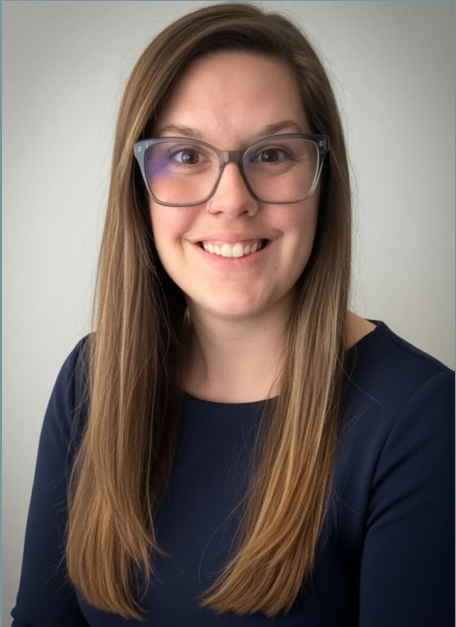
Tylon Staggs, PMHNP-BC
Tylon is a board-certified psychiatric-mental health nurse practitioner serving adults across Ohio via telehealth. She founded Open Chair Psychiatry & Mental Wellness on the belief that thoughtful psychiatric care shouldn’t be hard to access. See conditions treated.
Educational only. The information in this article summarizes general findings from psychiatric research literature and is not medical advice. Treatment decisions are individualized and made during a clinical evaluation. If you are in crisis or thinking about harming yourself, please call or text 988 or go to your nearest emergency room.