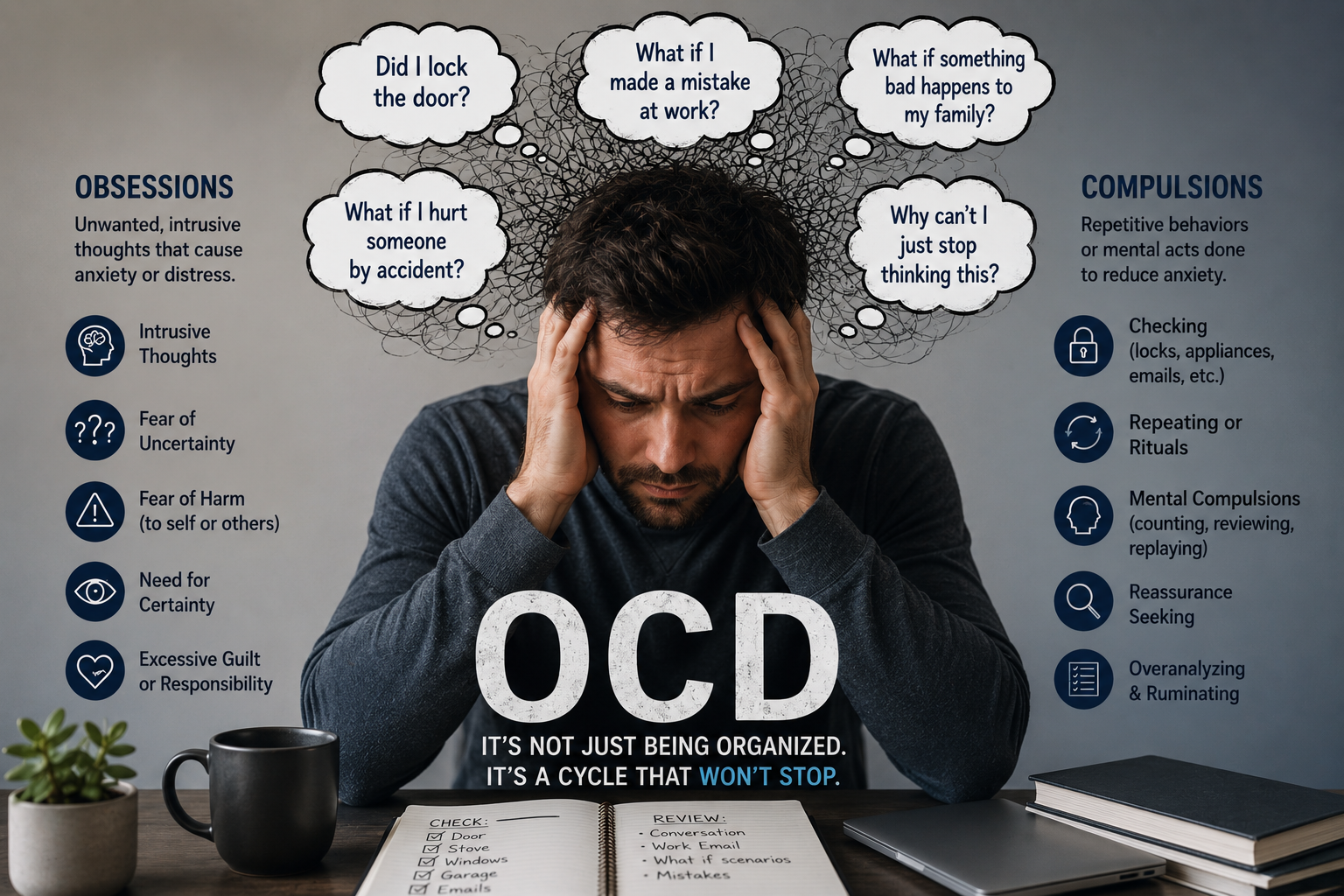
When most people think about obsessive-compulsive disorder (OCD), they picture:
- excessive cleaning
- hand washing
- organization
- symmetry
But OCD in adults is often much more subtle — and many people live with symptoms for years without realizing what they are experiencing.
In reality, OCD can look like:
- nonstop overthinking
- intrusive thoughts
- mental checking
- reassurance seeking
- fear of making mistakes
- replaying conversations repeatedly
- needing certainty
- obsessive guilt
- “what if” thoughts that will not stop
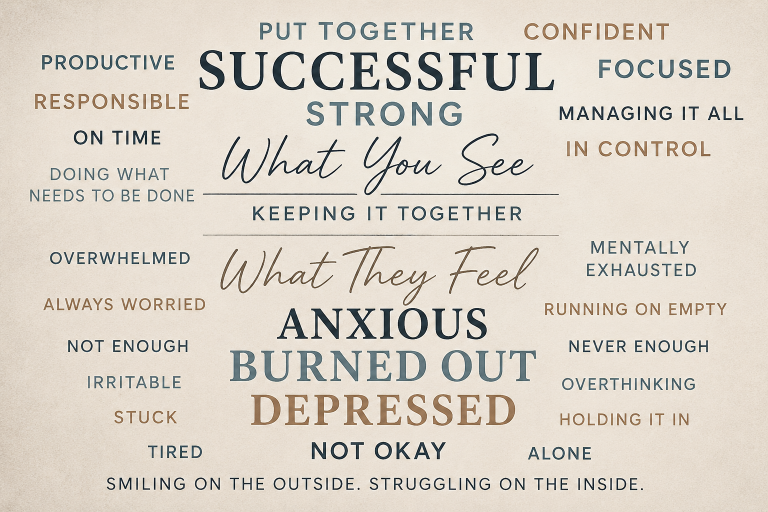
Many adults with OCD appear completely functional on the outside while privately struggling with exhausting mental rituals and anxiety.
At Open Chair Psychiatry & Mental Wellness, we provide telehealth psychiatric medication management for adults across Ohio and commonly work with individuals experiencing anxiety, intrusive thoughts, obsessive thinking, and OCD symptoms.
What Is OCD?
Obsessive-Compulsive Disorder is a mental health condition involving:
- obsessions (unwanted intrusive thoughts, fears, or mental images)
- and/or compulsions (behaviors or mental rituals done to reduce anxiety)
Many adults with OCD know their thoughts do not fully make sense, but the anxiety attached to the thoughts can feel extremely real and difficult to ignore.
OCD is not simply “liking things clean” or being highly organized.
It is often driven by intense anxiety, uncertainty, fear, guilt, or mental distress.
Common Hidden Signs of OCD in Adults
1. Intrusive Thoughts That Feel Disturbing or Distressing
One of the most misunderstood symptoms of OCD is intrusive thoughts.
These thoughts are:
- unwanted
- repetitive
- distressing
- difficult to dismiss
Examples may include:
- fear of harming someone accidentally
- disturbing mental images
- fear of contamination
- obsessive relationship doubts
- religious guilt or fears
- fears of losing control
- repetitive “what if” scenarios
Many adults with OCD become frightened by the thoughts themselves and worry:
“Why would my brain even think this?”
Having intrusive thoughts does not mean someone wants to act on them.
In fact, people with OCD are often deeply distressed precisely because the thoughts go against their values or character.
2. Constant Reassurance Seeking
Many adults with OCD repeatedly seek reassurance to temporarily reduce anxiety.
This may look like:
- asking others for validation repeatedly
- Googling symptoms excessively
- repeatedly checking if something is “okay”
- needing certainty before making decisions
- asking the same questions multiple times
Relief from reassurance is usually temporary, which causes the cycle to continue.
3. Mental Compulsions
Compulsions are not always visible.
Many adults with OCD perform mental rituals internally, including:
- mentally reviewing conversations
- replaying events repeatedly
- counting
- mentally checking memories
- repeating phrases internally
- trying to “cancel out” bad thoughts
- analyzing thoughts excessively
Because these behaviors happen internally, OCD is often missed or misunderstood.
4. Obsessive Guilt or Fear of Mistakes
Some adults with OCD experience overwhelming guilt or responsibility.
They may constantly worry:
- “What if I did something wrong?”
- “What if I accidentally hurt someone?”
- “What if I made a mistake and didn’t realize it?”
This can lead to:
- excessive apologizing
- repeated checking
- inability to let things go
- difficulty tolerating uncertainty
5. Repeated Checking Behaviors
Checking compulsions are common in OCD.
Examples include:
- checking locks repeatedly
- rereading emails or texts over and over
- repeatedly checking appliances
- checking health symptoms constantly
- reviewing work repeatedly for mistakes
The goal is usually to reduce anxiety or gain certainty — but the relief rarely lasts long.
6. Rumination That Never Seems to Stop
Rumination is another hidden symptom many adults experience.
This may involve:
- analyzing conversations repeatedly
- obsessing over past events
- mentally arguing with yourself
- trying to “solve” uncertainty
- getting stuck in endless thought loops
Many adults describe this as:
“My brain will not let things go.”
OCD in Adults Is Often Misdiagnosed
Because OCD symptoms can overlap with:
- anxiety
- perfectionism
- generalized worry
- health anxiety
- stress
- overthinking
…many adults do not realize OCD may be contributing to their symptoms.
Some people spend years believing they are simply:
- overly anxious
- overly sensitive
- perfectionistic
- “dramatic”
- bad at handling stress
Meanwhile, the obsessive-compulsive cycle continues underneath the surface.
What Causes OCD?
There is no single cause of OCD.
Research suggests OCD may involve a combination of:
- genetics
- brain chemistry
- environmental stressors
- anxiety vulnerability
- learned behavioral patterns
Symptoms may worsen during periods of:
- high stress
- major life changes
- burnout
- sleep deprivation
- increased anxiety
Can OCD Get Worse Over Time?
Without treatment, OCD symptoms can become more time-consuming and distressing.
Many adults notice:
- intrusive thoughts become more frequent
- compulsions become harder to resist
- anxiety increases
- reassurance seeking escalates
- daily functioning becomes more exhausting
Early recognition and treatment can help reduce symptom severity and improve quality of life.
Treatment for OCD in Adults
Treatment for OCD often includes:
- psychiatric medication management
- therapy approaches such as ERP (Exposure and Response Prevention)
- anxiety management strategies
- improving stress and sleep
- reducing compulsive behaviors
For some adults, medication may help reduce:
- intrusive thoughts
- obsessive thinking
- compulsive urges
- anxiety intensity
- rumination
Treatment is individualized based on symptoms, history, and patient goals.
When Should You Reach Out for Help?
It may be time to seek support if:
- intrusive thoughts are becoming distressing
- overthinking feels nonstop
- compulsions are interfering with daily life
- reassurance seeking feels excessive
- anxiety feels difficult to control
- mental rituals are exhausting
- symptoms are affecting sleep, work, or relationships
Many adults delay seeking help because they do not realize their symptoms may be related to OCD.
Telehealth Psychiatry for OCD in Ohio
At Open Chair Psychiatry & Mental Wellness, we provide telehealth psychiatric medication management for adults across Ohio.
We commonly work with adults experiencing:
- OCD symptoms
- intrusive thoughts
- anxiety
- rumination
- depression
- burnout
- emotional overwhelm
- sleep concerns
Virtual appointments allow adults across Ohio to access psychiatric care from home.
Frequently Asked Questions About OCD
Can OCD be completely internal?
Yes. Many adults experience primarily mental compulsions rather than visible behaviors.
Are intrusive thoughts normal?
Intrusive thoughts can happen to anyone occasionally. In OCD, the thoughts become repetitive, distressing, and difficult to disengage from.
Is OCD always related to cleaning?
No. OCD can involve many themes including relationships, health, harm fears, religion, responsibility, contamination, or intrusive thoughts.
Can OCD look like anxiety?
Yes. OCD and anxiety often overlap, and many adults initially believe they only have generalized anxiety or chronic overthinking.
Final Thoughts
OCD in adults is often misunderstood because many symptoms are invisible to others.
People may appear highly functional while privately struggling with intrusive thoughts, rumination, compulsive mental rituals, and constant anxiety.
Recognizing the hidden signs of OCD can help adults better understand what they are experiencing — and realize they are not alone.
About the Author
Tylon Staggs is a board-certified Psychiatric-Mental Health Nurse Practitioner providing telehealth psychiatric medication management for adults across Ohio through Open Chair Psychiatry & Mental Wellness.